
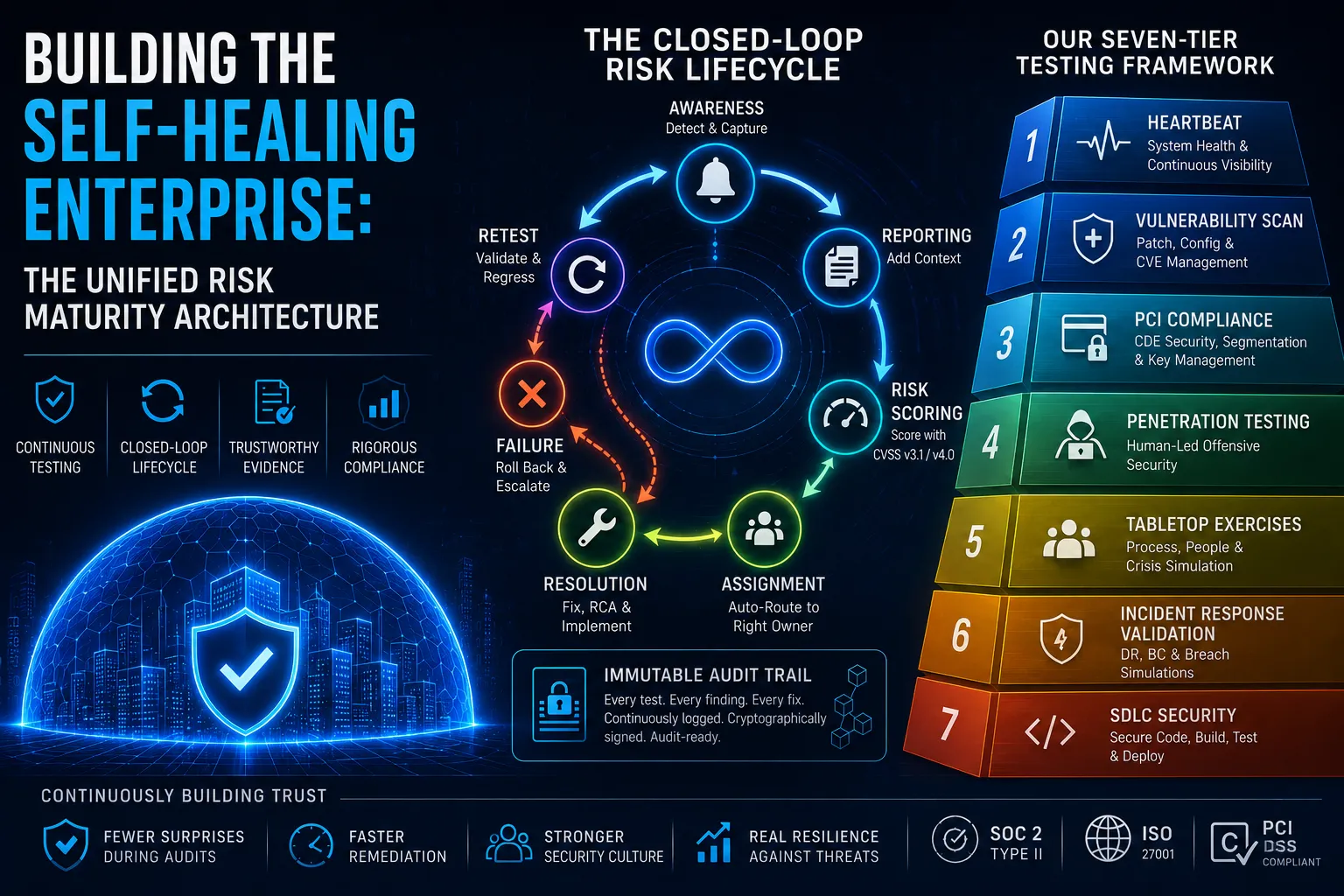
In today’s fast-moving digital world, many companies treat security and compliance like a yearly chore. They hire auditors, pull a few logs from a random day, get a clean report, and file it away until next year. Meanwhile, systems drift, vulnerabilities creep in, and the real risk level quietly worsens.
At Airius, we do things differently. We reject point-in-time compliance. Instead, we’ve built a living, breathing system that continuously tests, validates, and heals itself. This blog series is our transparent record of that journey—an engineering-first look at how we design, test, and prove our security every single day.
In this opening post, we’ll walk you through the complete blueprint of our Unified Risk Maturity Architecture. You’ll see the mathematical and operational loop that powers every security test, explore our seven-tier testing framework, and understand how our self-healing approach creates continuous, trustworthy evidence for rigorous compliance standards like SOC 2 Type II, ISO 27001, and PCI-DSS.
The Closed-Loop Risk Lifecycle Pattern
Everything at Airius starts with one unbreakable pattern: a closed-loop risk lifecycle. Whether it’s an automated script, a third-party audit, or a manual red-team exercise, every finding follows the same disciplined flow.
Think of it as a state machine with built-in memory and accountability. Successes strengthen our baseline. Failures trigger immediate regression and escalation until the issue is truly fixed.
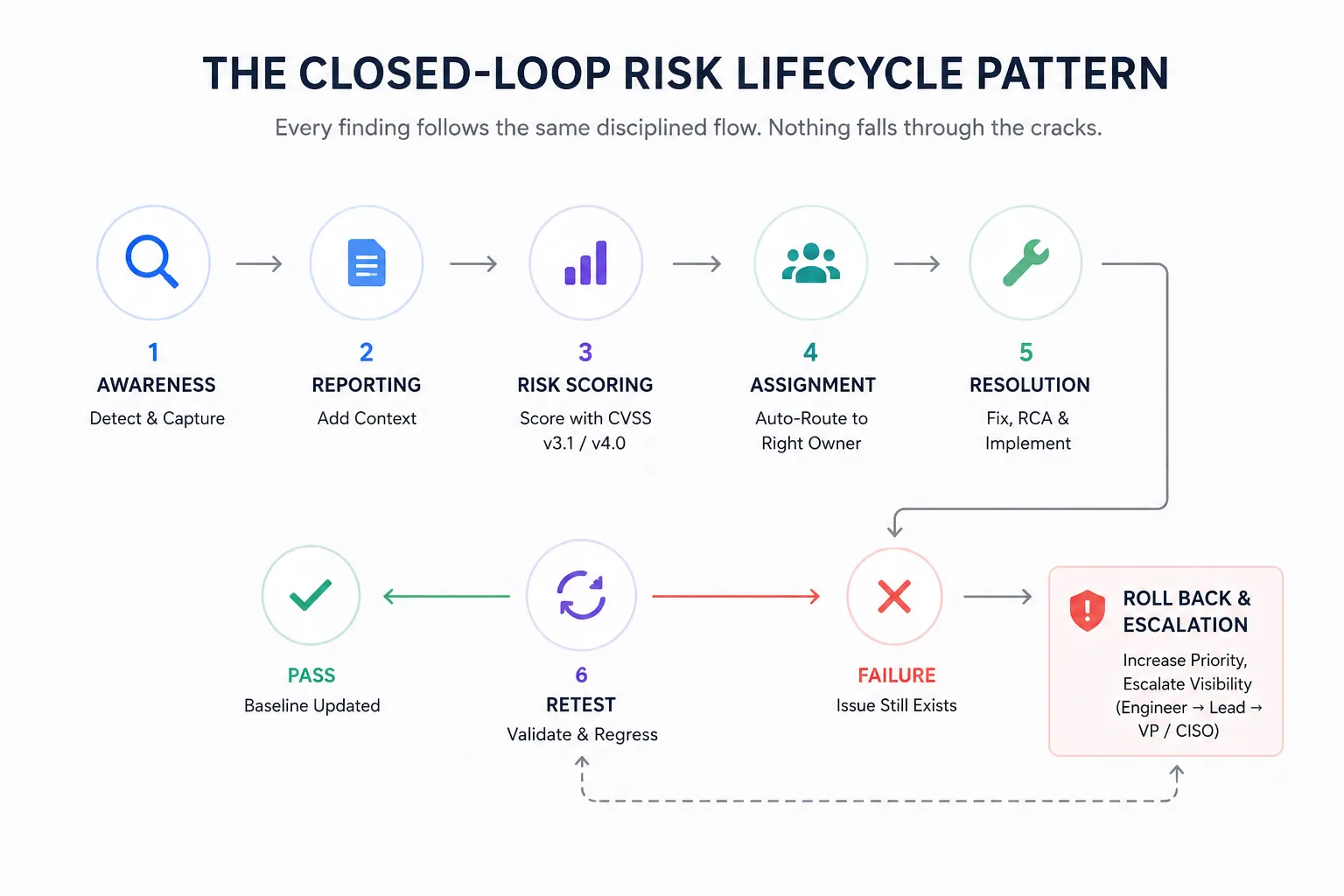
- Awareness This is the raw detection moment. It could be a monitoring alert, a failed synthetic test, a static analysis finding, or a red-team exploit. The data must be timestamped, hashed for integrity, and fed into our immutable logging system. No assumptions—just facts.
- Reporting Raw data gets contextualized. We capture the affected asset, environment (Dev/Staging/Prod), data classification, and version details. Context turns noise into actionable intelligence.
- Risk Scoring We use objective math, not gut feel. Every issue is scored with CVSS v3.1 or v4.0.
Base Score = f(Exploitability, Impact)
We then adjust with Environmental and Temporal factors specific to our setup:
Environmental Score = g(Base Score, Asset Criticality, Existing Controls)
Scores ≥7.0 (High) or ≥9.0 (Critical) trigger mandatory escalation and Root Cause Analysis (RCA).
- Assignment Tickets are auto-routed to the right owner based on code ownership and infrastructure maps. Clear SLAs apply:
- Critical (≥9.0): 24-hour mitigation
- High (≥7.0): 7-day remediation
- Medium (≥4.0): 30-day window
- Resolution A real fix is implemented—code change, configuration update, or control enhancement. High/Critical issues require a full RCA. All changes follow strict peer review, testing, and cryptographic signing.
- Retest & Regression Gate This is the secret sauce. We re-run the exact same test that found the issue.
- Pass → Update baseline, celebrate, move forward.
- Fail → Roll back visibility to the prior step, escalate priority and visibility up the chain (engineer → lead → VP/CISO if needed). No zombie vulnerabilities allowed.
This loop ensures nothing falls through the cracks.
Our Seven-Tier Testing Framework
We layer defenses progressively. Each tier builds on the reliability of the ones below it.
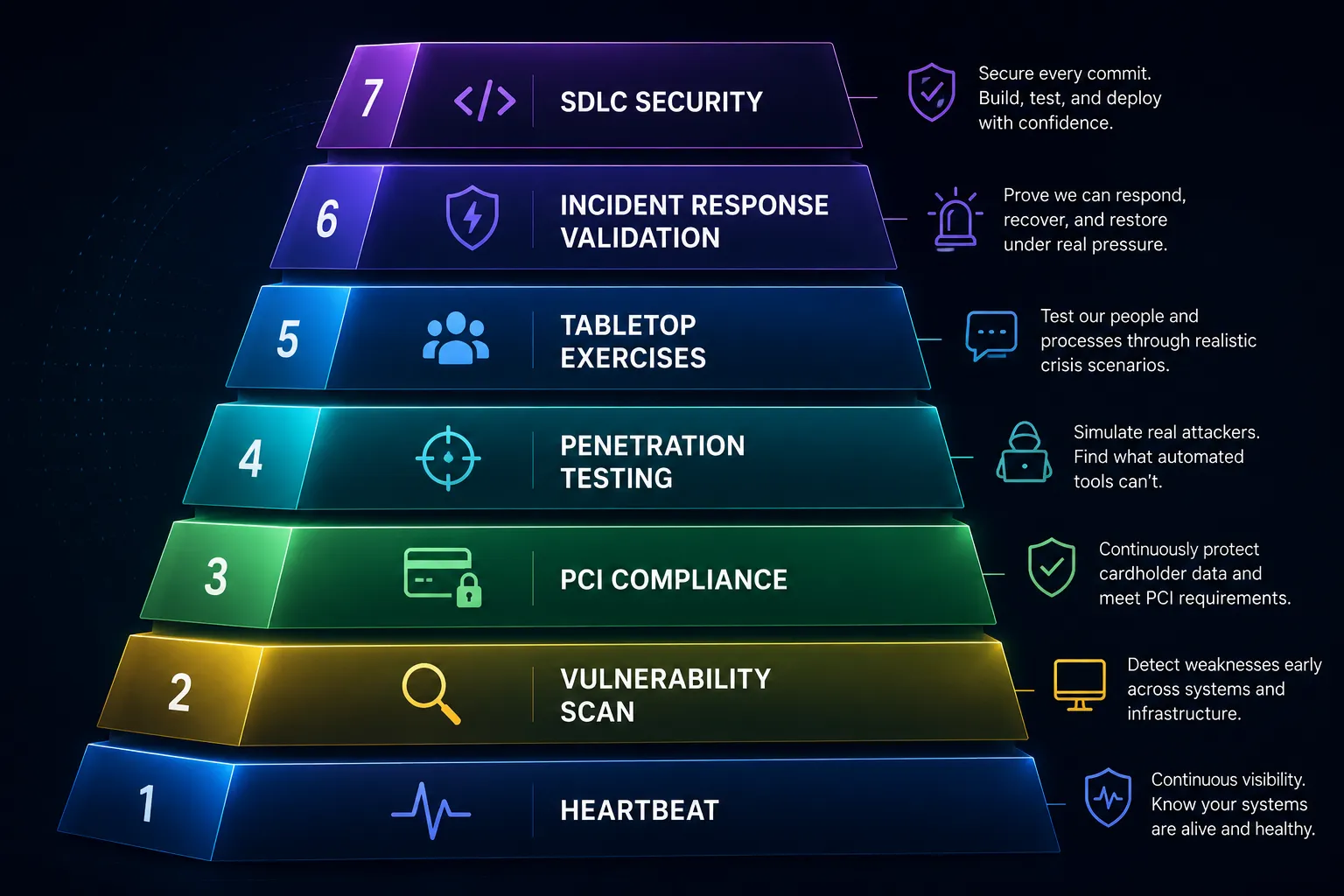
1. Heartbeat (Tier 1)
Before anything else, we need to know systems are alive.
Frequency: Continuous (sub-minute) Scope: Edge routers, ingress controllers, log pipelines
We send lightweight synthetic HTTP requests and cryptographic echoes through our systems. A single failed ping is minor, but sustained failures (over 3 minutes) escalate to Critical (CVSS 9.8) because they mean we’re flying blind.
The loop kicks in instantly: alert → page SRE → fix routing or config → 50 consecutive successful pings before clearing. This foundational visibility prevents higher-tier tests from producing false negatives.
2. Vulnerability Scan (Tier 2)
Frequency: Monthly + on-demand (after major changes) Scope: External perimeter, internal subnets, OS, libraries, daemons
Automated scanners check patch levels, open ports, weak protocols, and known CVEs. Success here depends on healthy Heartbeats—if a segment is unreachable, we can’t trust the scan.
When a vulnerability is found (e.g., outdated TLS library in a container):
- Awareness: Scanner logs the CVE and affected image.
- Reporting: Maps to Kubernetes node pool.
- Scoring: Elevated if in production with sensitive data.
- Resolution: Update base image via IaC.
- Retest: Targeted re-scan. Rollback + escalation on failure.
This tier catches the low-hanging fruit at scale.
3. PCI Compliance (Tier 3)
Frequency: Continuous tracking + quarterly attestations Scope: Cardholder Data Environment (CDE), network segmentation, key management
We zoom in on payment data systems. Checks verify isolation between corporate networks and the CDE, encryption key rotation, and comprehensive logging of PAN access.
A firewall rule drift that breaks segmentation is auto-scored Critical. The loop forces immediate revert, RCA, and re-verification with synthetic traffic tests. One leaked packet keeps the system in failed state and notifies leadership.
This continuous approach makes PCI compliance a natural byproduct of engineering rather than a painful audit scramble.
4. Penetration Testing (Tier 4)
Automated tools have limits. Humans think creatively.
Frequency: Annual + after major architecture changes Vectors: Authenticated (insider) and Unauthenticated (external)
- Unauthenticated: Starts from the public internet—recon, misconfigs, application flaws (XSS, SQLi, RCE).
- Authenticated: Assumes credentials are stolen—privilege escalation, data exfiltration across tenants.
Testers provide detailed exploitation narratives. Our loop ensures findings are scored, assigned, fixed with RCA (especially if scanners missed them), and retested by the same testers. Code rolls back on retest failure. This closes the gap between theoretical scans and real adversarial behavior.
5. Tabletop Exercises (Tier 5)
Technology is only half the battle. People and processes matter too.
Frequency: Semiannual/Annual Scope: Cross-functional teams (leadership, engineering, legal, PR, support)
We run discussion-based crisis simulations using real findings from lower tiers. Teams walk through evolving scenarios, testing playbooks and decision-making under pressure.
A gap (e.g., unclear legal escalation path) triggers the loop: document → report → score as High operational risk → update playbooks → retest in next simulation. Iterative refinement makes responses instinctive.
6. Incident Response Validation (Tier 6)
We move from discussion to live drills.
Frequency: Annual per track Tracks:
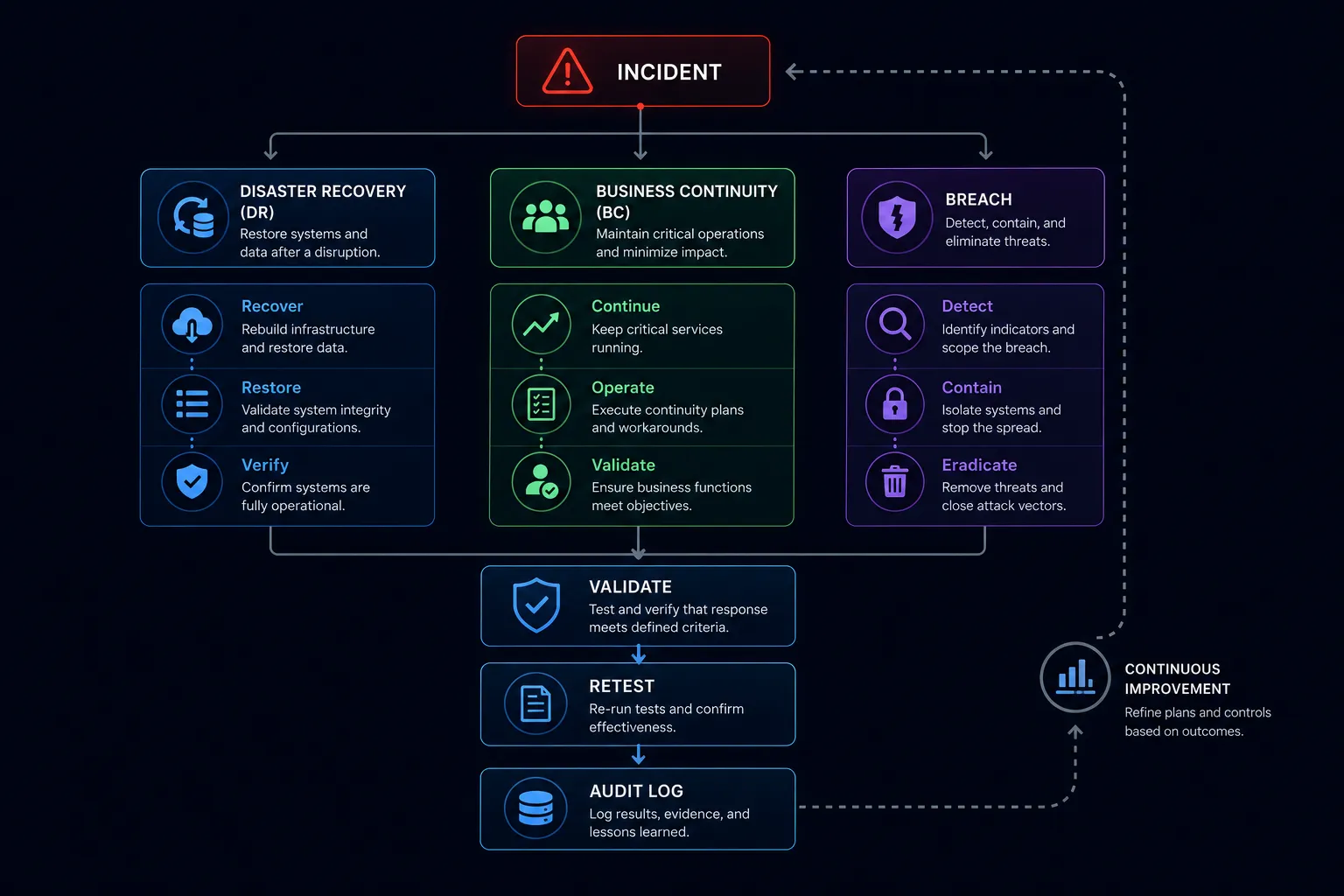
- Disaster Recovery (DR): Full region loss—rebuild with IaC, measure RPO/RTO.
- Business Continuity (BC): Vendor outages, identity provider failure, workforce disruption.
- Breach: Simulated malware, data exfiltration—detection, forensics, containment.
A failed DR test (e.g., recovery scripts exceed RTO) scores Critical. Engineers fix logic, publish RCA, and re-run in isolated staging until targets are consistently met. These tests prove we can survive real catastrophes.
7. Software Development Lifecycle (SDLC) – Tier 7
Security baked into every commit.
Frequency: Every CI/CD trigger
Components:
- SCA: Scans dependencies on commit (vulnerabilities + licenses).
- SAST: Analyzes source code for flaws like hardcoded secrets or injection risks.
- DAST: Attacks running apps in staging.
- Unit Testing: Edge-case validation.
- UAT: Business + security workflow checks.
- Change Validation: Peer review, test gates, artifact signing.
- Roll Back: Automatic revert on production issues.
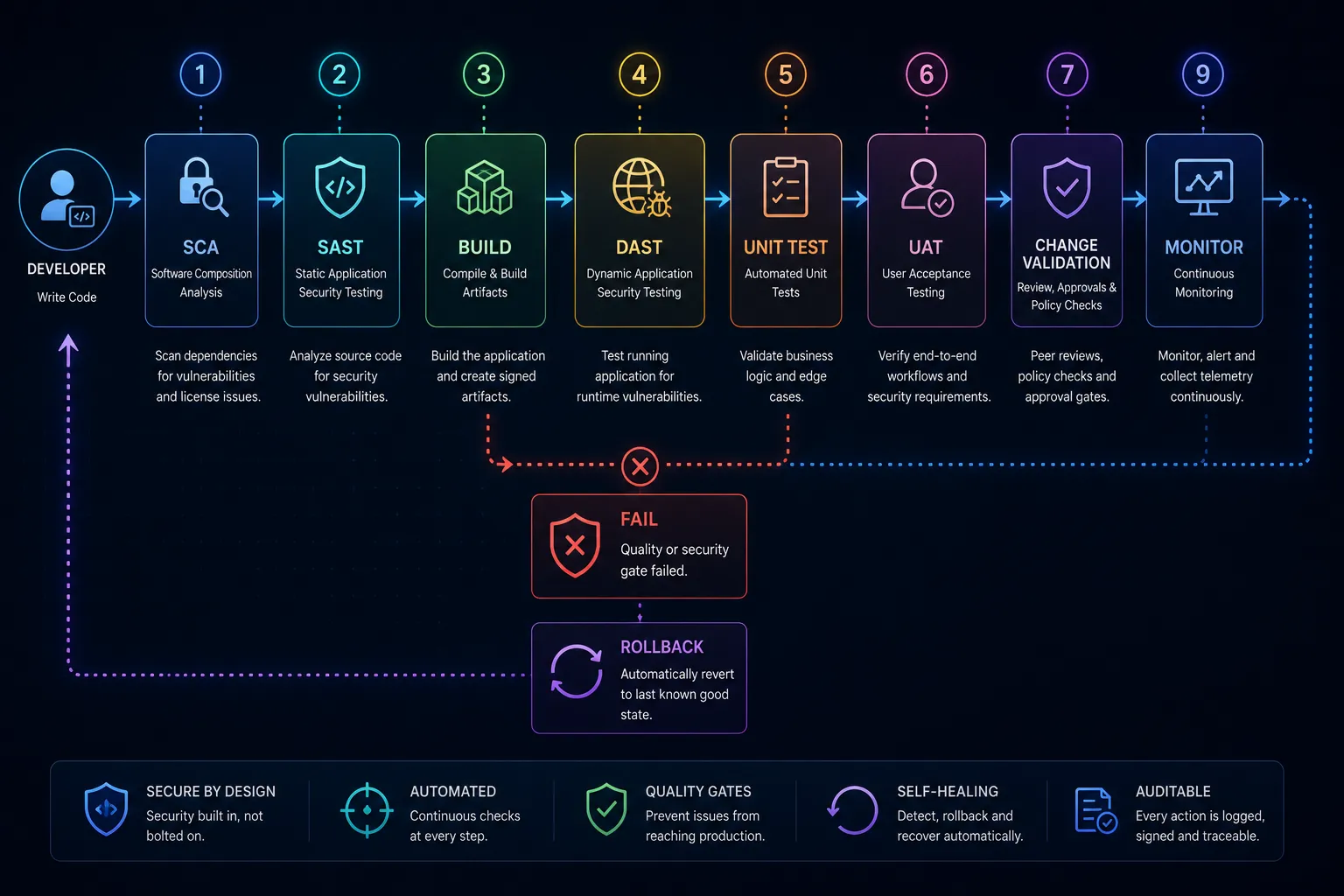
Example: A developer adds a vulnerable library. SCA blocks the merge instantly. The loop assigns it back to the engineer, who updates the dependency, re-runs the full pipeline, and only then proceeds. No risky code reaches production.
The Self-Healing Audit Trail
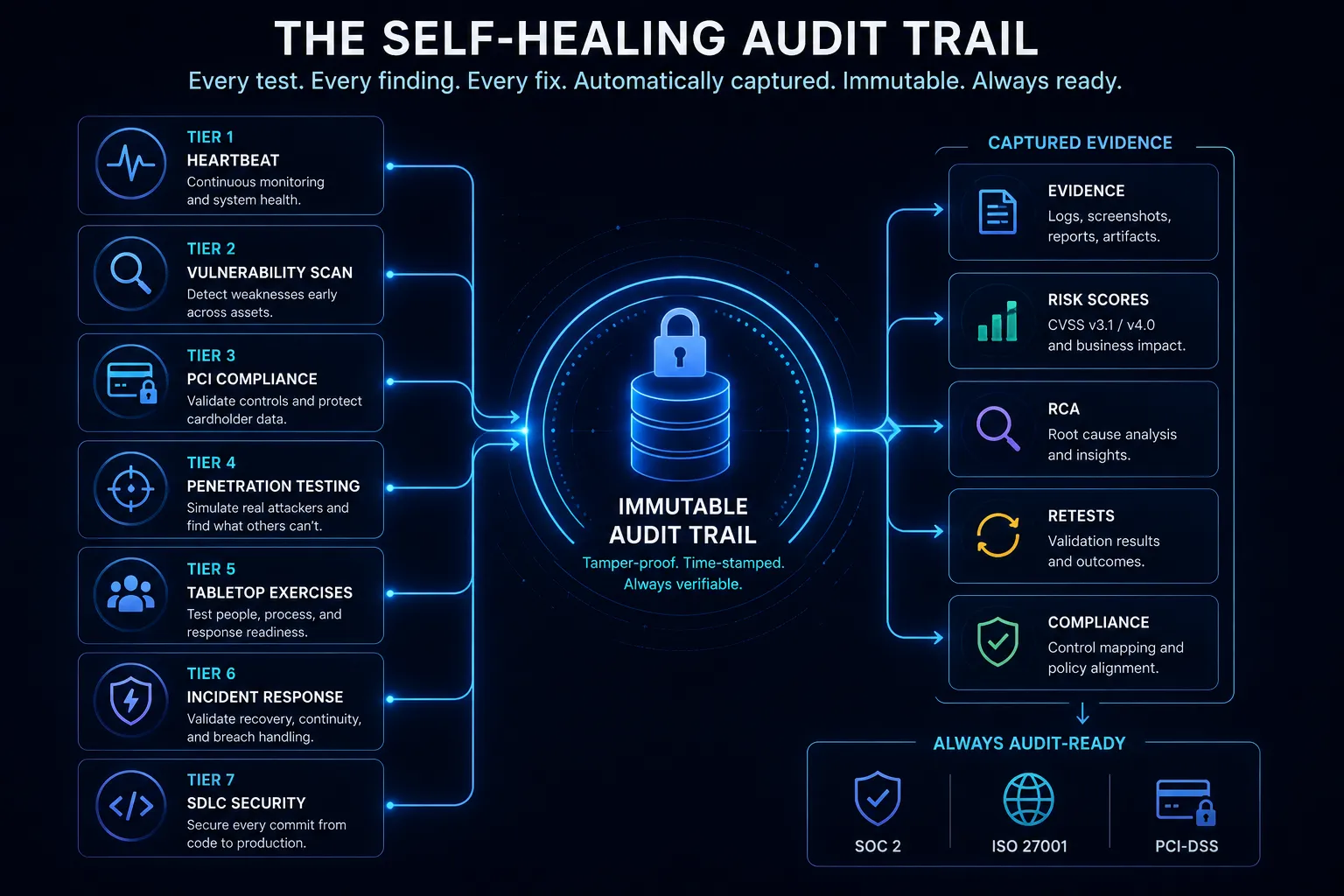
By wiring every tier into the same closed-loop pattern, Airius creates something powerful: a continuous, automated audit trail.
Every heartbeat, scan, pentest, simulation, and pipeline run generates structured, immutable evidence. Risk scores, ownership, RCAs, fixes, and retest proofs are all logged automatically. Auditors see living proof of control effectiveness—not dusty binders.
This approach delivers:
- Fewer surprises during formal audits
- Faster remediation
- Stronger security culture
- Real resilience against evolving threats
Compliance becomes a side effect of great engineering.
What’s Next?
This is just the overview. Future posts will dive deep into each tier with real examples, configuration snippets, lessons learned from actual incidents, and technical implementation details.
We’re committed to transparency. By sharing our playbook openly, we hope to raise the bar for the entire industry.
Stay tuned at airius.com/blog. Follow our journey as we build a truly self-healing enterprise—one test, one loop, one healed system at a time.